Not sure whether to repair or replace your water heater? This guide breaks down costs, lifespan expectations, and the decision framework that helps Monmouth County homeowners avoid overpaying.
Share:
Summary:
Your water heater isn’t getting hot. Maybe it’s making strange noises, leaking near the base, or just stopped working entirely. Now you’re facing a decision you didn’t budget for, and you need answers fast. Should you repair it or replace it? What’s this actually going to cost? And how do you know you’re not getting talked into something you don’t need?
The truth is, most homeowners don’t think about their water heater until it fails. Then suddenly you’re researching costs, calling plumbers, and trying to figure out if that repair quote makes sense or if you should just bite the bullet and replace the whole thing. This guide gives you the framework to make that call with confidence, starting with what actually drives water heater costs and when each option makes financial sense.
Water heater repair costs aren’t one-size-fits-all. You might pay $150 to fix a tripped breaker or thermostat issue, or you could be looking at $750 for a gas valve replacement or complex leak repair. The average lands around $500 to $600 for most homeowners, but that number moves based on what’s actually broken and how hard it is to fix.
The part itself is usually the smaller piece of the bill. Labor drives the final number, especially when your water heater is tucked in a tight crawl space, mounted in an attic, or requires shutting down other systems to access. If we need to drain the tank, reroute plumbing, or work around code compliance issues, those hours add up. Location matters too—Monmouth County’s coastal environment means parts corrode faster, and working with technicians familiar with salt air damage and hard water issues brings expertise that’s worth paying for.
When your water heater has no hot water, the fix could be simple or it could signal bigger problems. Start with the basics. For electric water heaters, a tripped circuit breaker is the most common culprit—and it’s free to reset. If that’s not it, you’re likely looking at a faulty heating element, which runs $100 to $350 including labor for replacement.
Gas water heaters follow a different troubleshooting path. If your pilot light went out, relighting it costs nothing if you can do it yourself. But if the pilot won’t stay lit, you might need a new thermocouple, which typically costs $150 to $300 installed. A failed gas valve—one of the pricier repairs—can run $200 to $500 depending on the model.
Thermostat problems fall somewhere in the middle, usually $150 to $250 to diagnose and replace. But here’s where it gets tricky. If you’re dealing with no hot water and your unit is over 10 years old, that “simple” heating element replacement might just be the first of several failures. The heating element works, but six months later the tank starts leaking. Now you’ve spent $300 on a repair and still need a $1,500 replacement.
This is why age matters as much as the repair quote. A $400 repair on a 4-year-old water heater makes sense. That same $400 repair on a 12-year-old unit? You’re probably throwing money at a system that’s already on borrowed time. The part might be fixable, but you can’t repair the internal corrosion that’s been building for over a decade.
Monmouth County homeowners face an additional challenge with hard water. The elevated calcium and magnesium in local water supplies accelerate sediment buildup inside the tank. That sediment acts like insulation between the heating element and the water, forcing your system to work harder and wear out faster. If your water heater has no hot water and you’ve never flushed the tank, sediment might be the real problem—and a $100 flush could buy you another year or two before replacement becomes necessary.
Here’s the decision framework the plumbing industry uses, and it cuts through a lot of confusion: if your repair cost exceeds 50% of what a new water heater would cost installed, replacement is almost always the smarter investment. It’s not a sales tactic. It’s math.
Say you get quoted $800 to repair your water heater, and a new unit installed would run $1,600. That’s exactly 50%—you’re at the tipping point. Now factor in age. If your current water heater is 11 years old, you’re repairing a system that statistically has 1-2 years left anyway. You spend $800 now, then $1,600 in 18 months when the tank finally fails. Total cost: $2,400. Or you spend $1,600 now and get a new unit with a fresh warranty, better efficiency, and 10-12 years of reliable service ahead.
The 50% rule becomes even more important when you’ve had multiple repairs. If you’ve called for service twice in the past year, that pattern tells you something. Individual components are failing because the whole system is aging out. Fixing one part doesn’t stop the next part from failing. You’re not buying long-term reliability—you’re buying a few more months, maybe a year if you’re lucky.
This is where transparent pricing matters. You need to know both numbers to apply the 50% rule: what the repair actually costs, and what replacement would cost. Some companies inflate the replacement quote to make the repair look better, or they lowball the repair to get in the door, then discover “additional problems” once they’re there. Upfront pricing means you can do the math yourself and make the call that’s right for your situation.
For Monmouth County homeowners, there’s another factor in this equation. Coastal humidity and salt air corrode water heater components faster than they would inland. A 10-year-old unit here has faced tougher conditions than the same model would in central New Jersey. That accelerated wear means the 50% rule might kick in earlier—your unit might be in worse shape at 9 years than the industry average at 11 years.
One more thing the 50% rule doesn’t account for: energy efficiency. If you’re repairing a 12-year-old water heater, you’re keeping an inefficient system running. New models use 20-30% less energy than units from 2014. That efficiency gap means higher utility bills every month you keep the old unit running. Over a year, that could be $100-$200 in wasted energy costs—money that could’ve gone toward paying off a new, efficient replacement.
If your water heater isn’t getting hot enough or the temperature keeps fluctuating, you’re dealing with one of the most common complaints homeowners face. The question isn’t just what’s wrong—it’s whether fixing it makes sense given how old your system is and what else might fail next.
Start by checking the simple stuff. Your thermostat might be set too low, especially if someone adjusted it to prevent scalding or save energy. The standard setting is 120°F, which balances safety and performance for most households. If turning up the thermostat doesn’t help, you’re looking at a component failure: heating elements in electric units, or burner assembly issues in gas models.
But here’s the part most homeowners don’t realize until it’s too late. When your water heater isn’t getting hot, that symptom could point to a $200 fix or a $2,000 problem, and the only way to know is a proper diagnosis. This is where age becomes your most important data point.
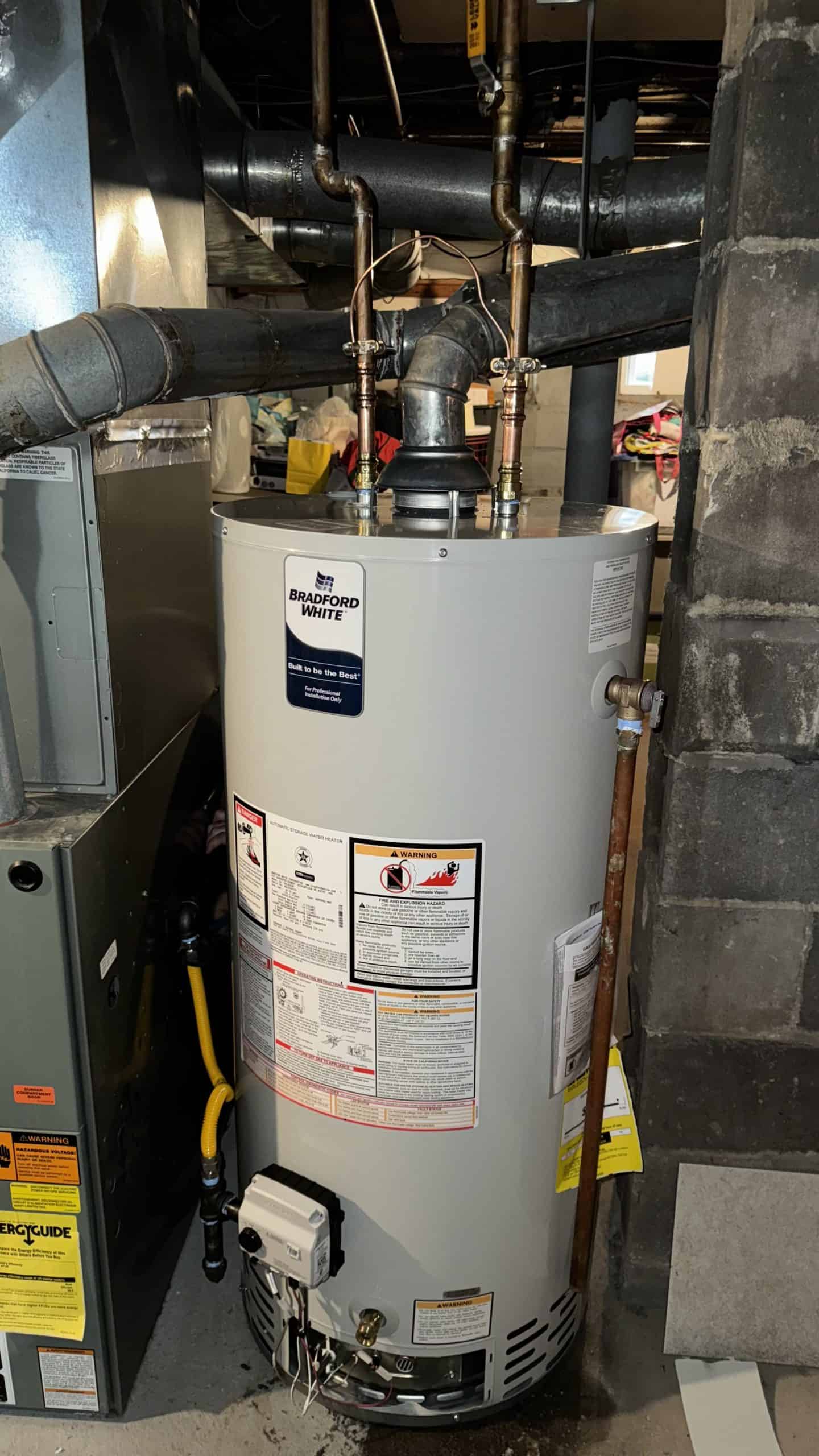
Your water heater’s age tells you more about whether to repair or replace than almost any other factor. Here’s how to think about it.
If your unit is under 6-8 years old and the repair is straightforward—a heating element, thermostat, or pressure relief valve—repair almost always makes sense. You’re fixing a relatively young system that should have years of life left. Even a $400-$500 repair is reasonable when you’re getting another 4-6 years of service.
The middle zone is 8-10 years old. This is where you need to weigh the repair cost against remaining lifespan. Tank-style water heaters average 8-12 years total, so you’re in the final third of the unit’s expected life. A minor repair might be worth it. A major component failure probably isn’t. This is exactly where the 50% rule becomes your guide.
If your water heater is over 10-12 years old, replacement is usually the right call regardless of what’s broken. Even if the repair only costs $300, you’re spending that money on a system that’s already outlived its expected lifespan. You might get another year out of it, or it might fail again in three months. That uncertainty costs you in stress and planning, not just money.
Tankless water heaters follow a different timeline. They typically last 15-20 years, so a 10-year-old tankless unit is only at the midpoint of its lifespan. Repairs make more sense on tankless systems until they hit the 12-15 year mark. But tankless units have their own considerations—they require annual descaling in areas with hard water like Monmouth County, and if that maintenance has been skipped, mineral buildup can cause expensive damage that looks like a simple “not heating” problem but actually requires extensive cleaning or heat exchanger replacement.
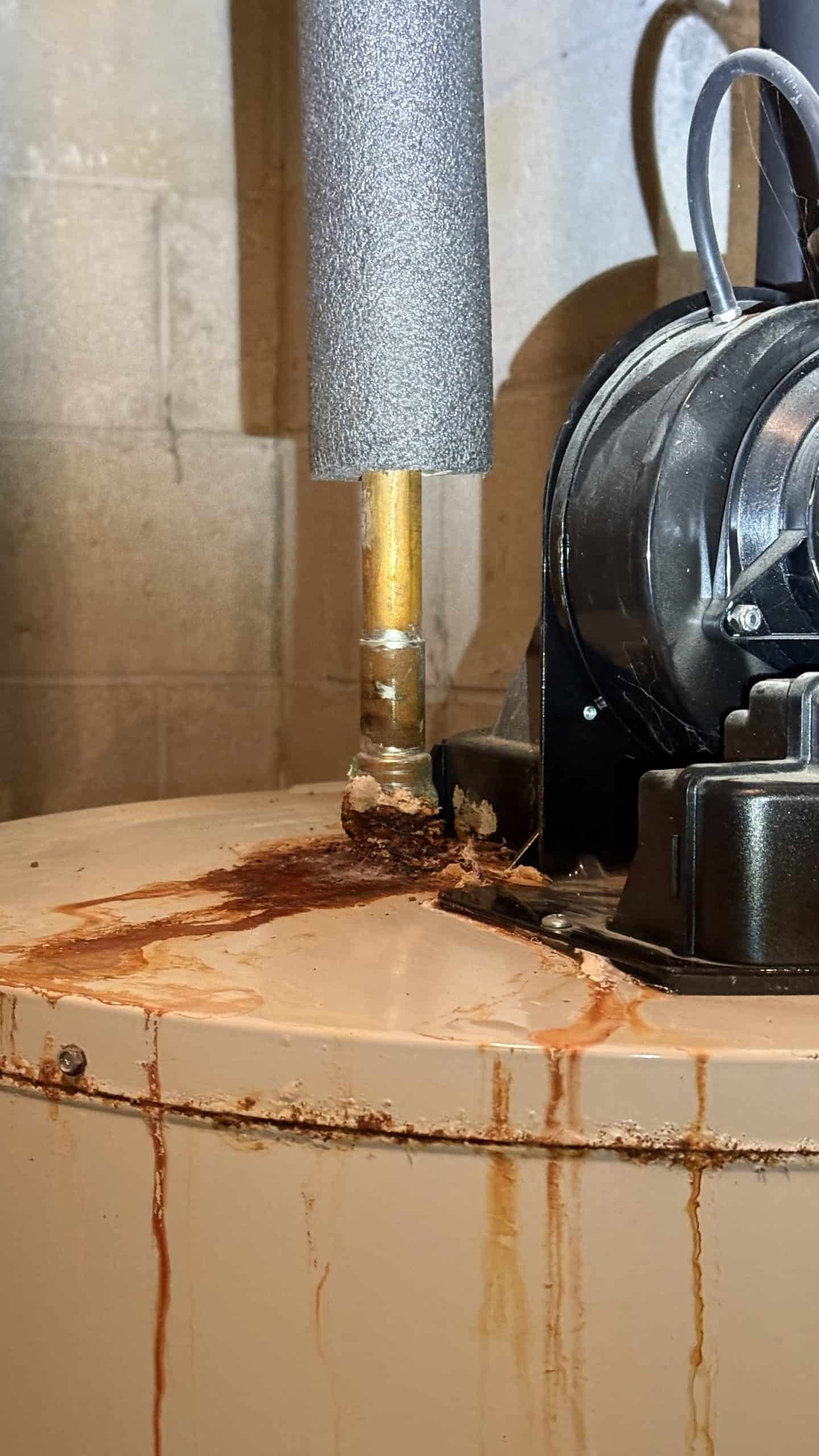
One warning sign that age is catching up to your water heater: rust-colored or discolored hot water. That’s internal corrosion, and it means the protective lining inside your tank is failing. You can’t repair that. Once the tank itself is corroding, you’re on borrowed time. The same goes for water pooling at the base of the unit. Small leaks from valves or connections can be fixed. Water leaking from the tank body means the metal has failed, and replacement is your only option.
Monmouth County’s water conditions accelerate this aging process. Hard water deposits build up faster here than in areas with softer water. Coastal humidity promotes rust. Salt air corrodes external components and connections. A water heater that might last 12 years in central New Jersey might only make it to 10 years near the coast. If you’ve never flushed your tank to remove sediment buildup, that lifespan drops even further—some units fail at just 6-8 years when maintenance is ignored.
When a tankless water heater stops heating, you’re dealing with a different set of problems and costs than traditional tank systems. Tankless units are more complex, which means repairs can be pricier, but they also last longer and run more efficiently when they’re working properly.
The most common issue is mineral buildup in the heat exchanger. In Monmouth County’s hard water environment, calcium and magnesium deposits accumulate quickly inside the narrow passages where water gets heated. This scaling reduces efficiency first—you’ll notice the water isn’t as hot as it used to be—then eventually causes the unit to shut down entirely. Descaling typically costs $150-$300 and should be done annually if you have hard water. If you’ve skipped this maintenance for several years, the buildup might be severe enough that you need a full heat exchanger replacement, which can run $500-$800.
Ignition failures are another common culprit. If your tankless water heater not heating up comes with an error code about ignition, you might be dealing with a faulty igniter, gas supply issues, or vent blockages. Replacing an igniter usually costs $200-$400. Clearing a blocked vent is cheaper, often $100-$200, but it requires us to inspect the entire venting system to make sure it’s up to code and functioning safely.
Flow rate problems can also make it seem like your tankless unit isn’t working. These systems need a minimum flow—usually 0.3 to 0.5 gallons per minute—to activate the burner. If you’re trying to use a low-flow faucet or the aerator is partially clogged, the unit simply won’t turn on. This isn’t a repair issue; it’s a usage issue. But if you’ve recently added a water softener or filtration system, those can reduce flow enough to cause problems.
The “cold water sandwich” effect confuses a lot of homeowners. You turn on hot water, get hot water for a few seconds, then cold water, then hot again. That’s not a malfunction—it’s how tankless systems work. The initial hot water is what was left in the pipes from last time. Then cold water flows through while the unit fires up. Then you get continuous hot water. If this bothers you, a small buffer tank can solve it, typically adding $300-$600 to your system cost.
Here’s where tankless units differ from tank systems in the repair-or-replace decision: because they last 15-20 years, a $500 repair on a 10-year-old tankless unit might make perfect sense. You’re at the midpoint of its lifespan, not the end. That same $500 repair on a 10-year-old tank system would be questionable because tank systems are already near the end of their expected life at that age.
But there’s a catch. If your tankless water heater has never been descaled and it’s more than 5-6 years old, the damage from mineral buildup might be extensive. You could spend $300 on descaling only to discover the heat exchanger is permanently damaged and needs replacement. At that point, you’re looking at $800-$1,200 in repairs on a unit that’s been poorly maintained. Depending on the age and overall condition, replacement might actually be the better investment even though tankless units typically last longer.
The upfront cost of tankless replacement is higher—usually $1,400 to $5,600 depending on the size and fuel type. But the energy savings are real. Tankless units can save you $100-$200 per year compared to keeping an old tank system running. Over the 15-20 year lifespan of a tankless unit, that’s $2,000-$4,000 in energy savings. When you’re making the repair-or-replace decision, factor in those operating costs, not just the installation price.
Water heater problems don’t wait for convenient timing, but you don’t have to make this decision blind. You now know the framework: repair costs under 50% of replacement on a unit under 8 years old usually make sense. Repair costs over 50% on a unit over 10 years old usually don’t. Everything in between comes down to your specific situation—how well the unit’s been maintained, what else might fail soon, and whether you’re ready to upgrade to better efficiency.
The real cost isn’t just what you pay today. It’s what you’ll pay over the next few years in repeated repairs, higher energy bills, and the risk of water damage if the tank fails catastrophically. A $600 repair might seem cheaper than a $1,800 replacement right now, but if that repair only buys you six months before the next failure, you haven’t saved anything.
If you’re in Monmouth County or Ocean County and you’re facing this decision, we can walk you through the actual numbers for your specific water heater. You’ll get transparent pricing on both repair and replacement options, no pressure tactics, and the information you need to make the call that’s right for your home and budget.
Article details:
Share:
Continue learning: