Reviews
Upper Freehold properties aren’t your typical suburban lots. When your lateral line runs hundreds of feet from the house to the septic tank — crossing under paddocks, driveways, and tree lines that have been growing for decades — a sewer problem is a different kind of problem. It’s not just the repair cost. It’s what getting to the pipe might destroy along the way.
That’s exactly why trenchless sewer repair matters here more than almost anywhere else in Monmouth County. Where the pipe condition allows it, we can reline or restore your line from small access points — no wide excavation across your property, no torn-up landscaping, no backhoe through your paddock. You get a repaired sewer line and a yard that still looks like yours when we leave.
Beyond protecting what you’ve built on the surface, fixing a broken or blocked sewer line protects the home itself. Sewage backing up into your house causes real damage fast — floors, walls, HVAC systems. On a property worth $850,000 or more, a delayed repair is never the cheaper option. Getting it handled now, with a licensed Monmouth County plumber who knows how to work on large rural properties, is the decision that holds up.
We’ve been serving Monmouth County since 2014 — family-owned, locally rooted, and based out of Manasquan. That puts us about 25 to 30 minutes from Upper Freehold, which is close enough to respond fast but more importantly, close enough to know the area. We’ve worked on properties throughout Upper Freehold and the surrounding townships, we understand what rural infrastructure looks like out here, and we’re not guessing when we show up.
We’re fully licensed and insured under New Jersey’s plumbing codes, and every job we take on in Upper Freehold goes through the township’s Construction Department permit process — we handle that, not you. Our technicians are named in our reviews because they’re accountable people, not anonymous crews. When customers have compared our quotes to what A.J. Perri and Roto-Rooter came in at, we’ve consistently come out as the better value — and the work has backed that up.
The first thing we do is run a camera through your sewer line. A fiber optic cable goes in, and you get real video footage of what’s actually happening inside the pipe — whether that’s a root intrusion from one of those mature trees on your property, a crack from years of soil movement, a sagging section, or a full blockage. On a large Upper Freehold lot with extended lateral runs, this step isn’t optional. It’s how we know exactly where the problem is and what it actually requires before recommending anything.
Once we know what we’re dealing with, we walk you through your options clearly. If trenchless pipe lining or pipe bursting is viable based on the pipe’s condition, we’ll tell you that. If a section needs to be excavated and replaced, we’ll tell you that too — along with exactly what it will cost before work begins. No surprises, no scope creep, no pressure.
From there, the repair gets done. If it’s a permit-required job — which most sewer line work in Upper Freehold Township is — we coordinate with the township’s Construction Department so you don’t have to navigate that process yourself. When properties involve septic-adjacent systems, we’re also familiar with the Monmouth County Board of Health requirements that may apply. The goal is a clean repair, a clear explanation, and a system that works when we leave.
Ready to get started?
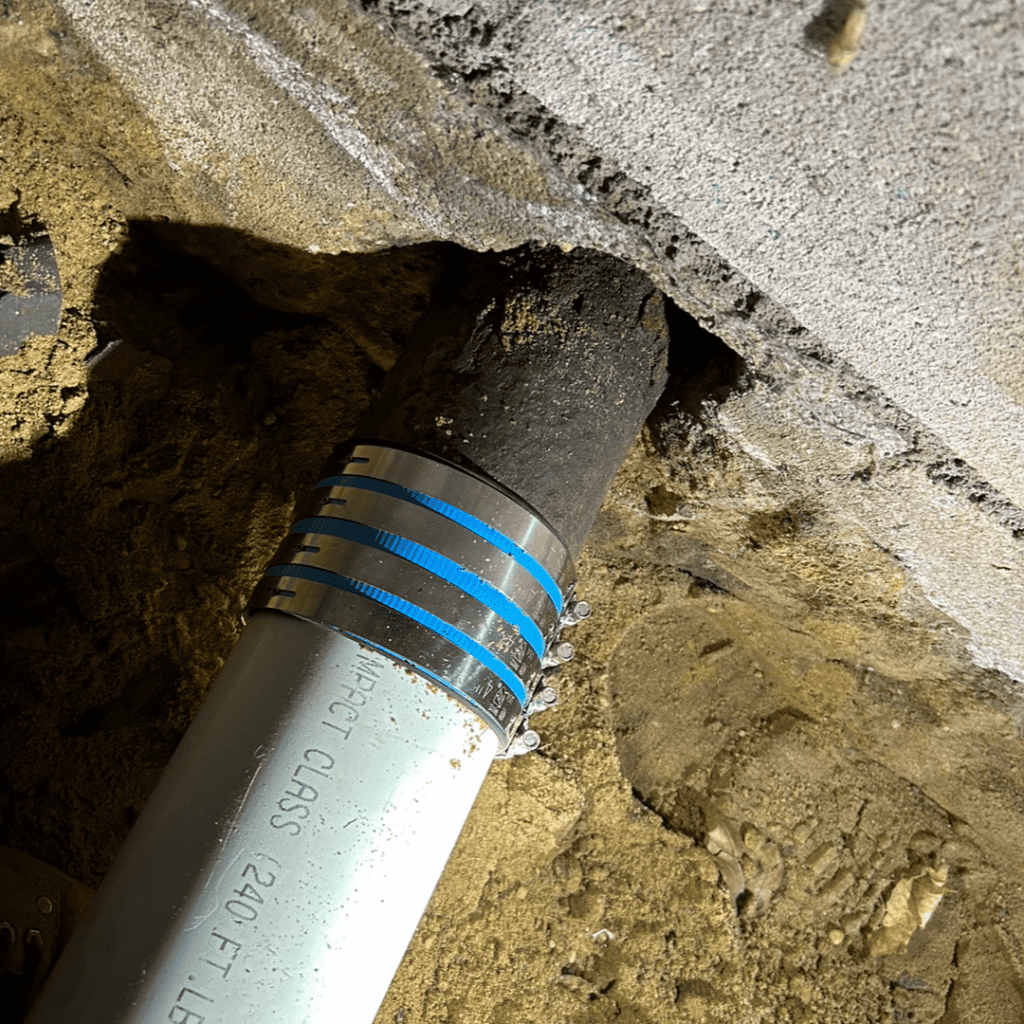
Sewer line repair covers more ground than most people realize when they first call. Depending on what the camera inspection reveals, the work might involve trenchless pipe lining — where a resin-coated liner is inserted and cured inside the existing pipe to seal cracks and restore flow — or pipe bursting, which replaces the old pipe by fracturing it outward while pulling a new one through. For main line clogs caused by root intrusion or buildup, hydro jetting or mechanical clearing may be the right call before any structural repair is needed. Every Upper Freehold property gets assessed on its own terms.
For homes throughout Upper Freehold and the surrounding areas, the most common issues we see are root intrusion from mature trees on large lots, pipe deterioration in homes built before 1980 — many of which still have original clay tile or cast iron lines — and joint separation caused by years of soil movement across acreage. If your home was built between 2000 and 2009, that puts your lateral lines at 15 to 25 years old, which is right in the window when first-time issues tend to show up.
Right now, we’re offering $250 off sewer line repairs and $500 off full sewer line replacements. If you’re active military, a veteran, or a first responder, there’s an additional 10 percent off on top of that. And if the scope of the repair is larger than you were expecting, 0% financing is available — because a necessary repair shouldn’t have to wait because of timing.
This is one of the most common questions we get from Upper Freehold homeowners, and it’s a fair one — because unlike towns with public sewer connections, a lot of properties out here are on private septic systems, which means the infrastructure is entirely yours from the house to the tank and beyond. The symptoms often look the same on the surface: slow drains, gurgling sounds, sewage smells, or backups at multiple fixtures.
The honest answer is that you usually can’t tell from symptoms alone. What you need is a camera inspection. We run a line through your system and can identify whether the issue is in the lateral line connecting your home to the tank, inside the distribution system, or somewhere else entirely. From there, we can tell you exactly what you’re dealing with and what it will take to fix it — before you’ve committed to anything.
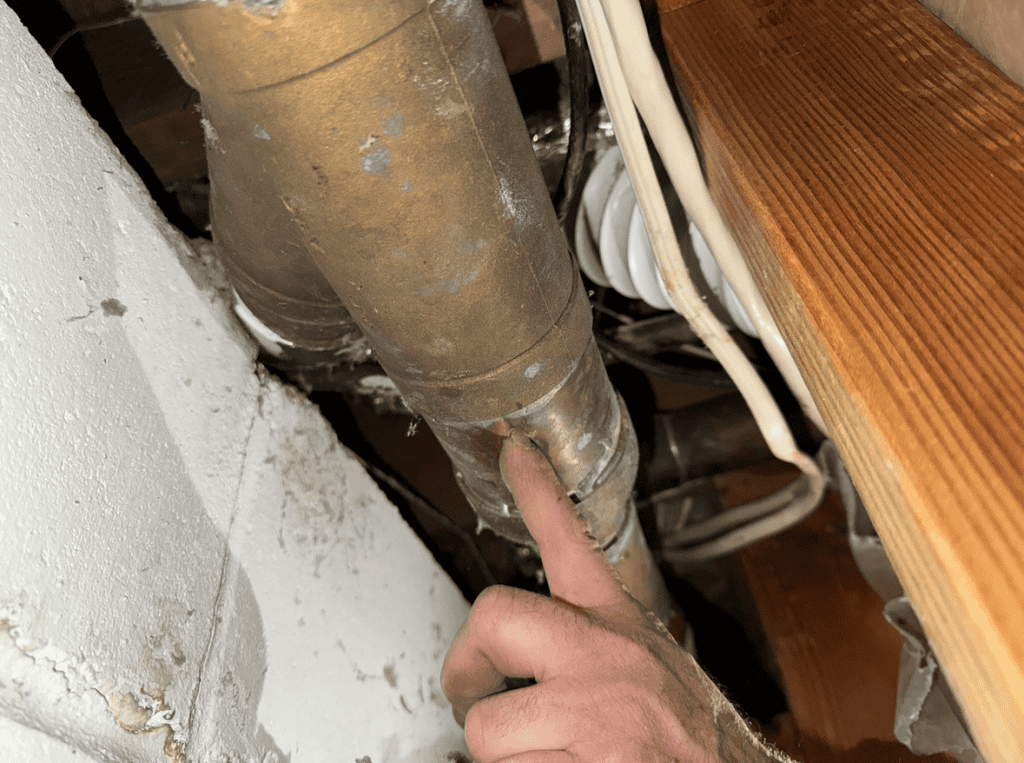
On Upper Freehold properties, the two most common culprits are root intrusion and pipe age. When you have mature trees — oaks, maples, willows — growing on a large lot with a lateral line running hundreds of feet underground, those roots will find the pipe. Clay tile and cast iron pipes, which are common in homes built before 1980, are especially vulnerable because roots can work through the joints and cracks in those materials over time.
Soil movement is the other major factor. Upper Freehold sits on the Inner Coastal Plain, and the mix of clay and sandy soil in this part of Monmouth County shifts with freeze-thaw cycles, heavy rain, and ground saturation — especially in spring when the ground thaws after a hard winter. That movement stresses pipe joints and connections, and over years, it opens gaps that let roots in or causes sections to sag and collect debris. If your home was built in the 1980s or earlier and you’ve never had your sewer line inspected, it’s worth knowing what’s down there.
In many cases, yes — and for Upper Freehold properties specifically, this is often the most important question to ask before any work begins. Trenchless sewer repair methods like pipe lining (CIPP) and pipe bursting allow us to restore or replace a damaged line from small access points, without excavating a trench across your property. For an Upper Freehold property with a long driveway, a paddock, or landscaping you’ve invested years in, this is a meaningful difference.
That said, trenchless isn’t always the right answer. It depends on the condition of the existing pipe — if the pipe has fully collapsed or is severely misaligned, trenchless methods may not be viable and traditional excavation may be necessary. The camera inspection tells us which situation you’re in before we make any recommendation. We’ll always tell you what’s actually needed, not what’s easiest to sell.
Sewer line repair in New Jersey typically runs between $1,400 and $5,000 for most repair scenarios, with full replacements potentially reaching $7,500 or more depending on pipe depth, length, material, and access conditions. Upper Freehold properties can push toward the higher end of that range because lateral lines on large rural lots are often longer than a standard suburban run, which means more linear footage to inspect, repair, or replace.
The best way to get an accurate number is to start with a camera inspection so we know exactly what we’re dealing with. From there, you get a clear, upfront quote before any work starts — no estimates that balloon once we’re already on-site. We’re currently offering $250 off sewer line repairs and $500 off replacements, and 0% financing is available if the project scope is larger than you were planning for. We’d rather give you a real number upfront than a low one that surprises you later.
Yes, in most cases. Significant sewer line work in Upper Freehold Township requires a construction permit through the township’s Construction Department, and the plumbing subcode application must be signed and sealed by a licensed New Jersey Master Plumber. We hold that license, and we handle the permit process as part of the job — you don’t need to figure out how to navigate the township’s Construction Department on your own.
If your property involves a septic system, there’s an additional layer: the Monmouth County Board of Health may need to review and approve certain work before a certificate of occupancy or final permit can be issued. We’re familiar with both processes and coordinate them together so the job moves forward without delays on your end. Skipping the permit process might seem like a shortcut, but it creates real liability when you go to sell the property — and in a market where Upper Freehold homes are selling at or above $850,000, that’s not a risk worth taking.
Upper Freehold homeowners are dealing with a specific set of circumstances that make sewer repairs more unpredictable than in a typical suburb. Private infrastructure, large lots, older pipe materials, and extended lateral runs mean that when something goes wrong, the scope can be harder to predict from the outside. The $250 off sewer line repair and $500 off replacement discounts exist because we want the cost of getting it done right to be less of a barrier — especially when a repair arrives without warning and wasn’t in anyone’s budget.
The 10 percent discount for military personnel, veterans, and first responders reflects the same thinking. Monmouth County has a significant population of people who serve and have served, and that deserves a straightforward acknowledgment, not a footnote. If you’re financing a larger repair through our 0% option, these discounts apply to the total before financing — so the savings are real either way. Call us, get the inspection done, and we’ll show you exactly what you’re working with before any decision gets made.