Reviews
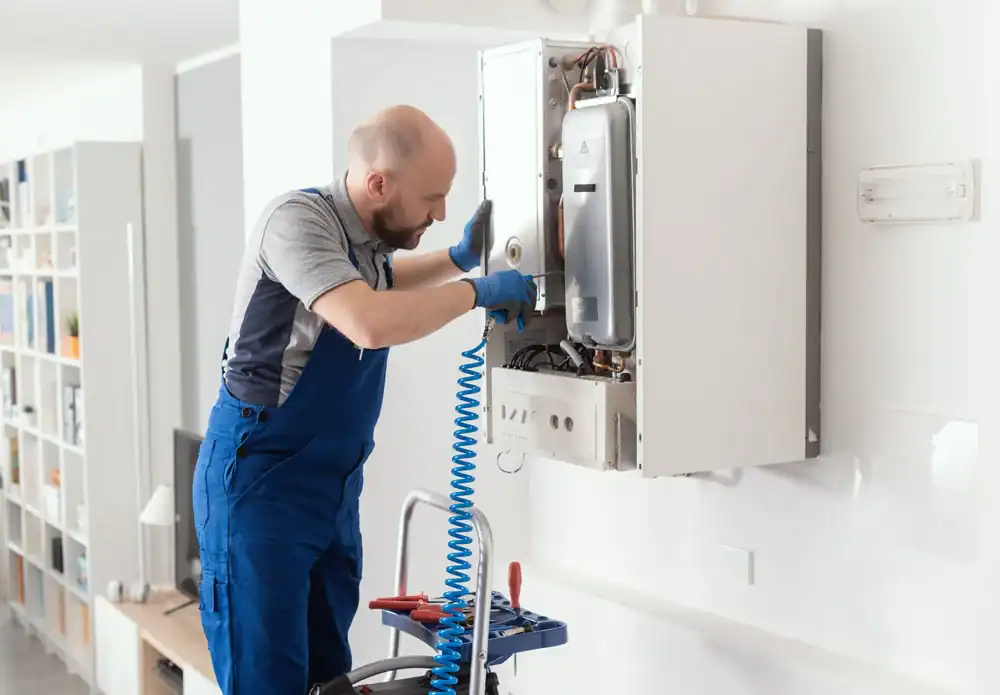
Most boiler calls aren’t complicated — they’re just handled badly. The technician shows up late, gives you a vague diagnosis, and hands you a bill that doesn’t match what was discussed. That’s the experience we were built to replace. When the job is done, your heat works, your price matched the estimate, and you actually understood what happened.
Red Bank’s housing stock is one of the oldest in Monmouth County. The majority of homes here were built before 1940, and a significant portion go back even further — late 1800s colonials near the Navesink River, early 20th-century multifamily buildings closer to downtown. These aren’t homes with modern forced-air systems. They have steam boilers, cast iron radiators, and decades of modifications layered on top of each other. Servicing them correctly takes experience with older systems, not just a general HVAC certification.
The Navesink River sits right at Red Bank’s edge, and that proximity matters more than most homeowners realize. The tidal estuary creates year-round humidity and salt-air exposure that accelerates corrosion in boiler components — heat exchangers, fittings, radiators — faster than you’d see in an inland community. That means your system is working harder and wearing faster. Catching problems early, or maintaining the system properly, isn’t just a nice idea here. It’s the difference between a $300 repair and a $6,000 replacement.
We’ve been serving Monmouth County since 2014 — a family-owned operation out of Manasquan that’s spent over a decade working on the kinds of homes Red Bank is full of. That means older systems, tighter spaces, and heating setups that don’t always follow the textbook. Our team knows the difference between a steam boiler that needs a $200 pressure adjustment and one that’s genuinely at the end of its life.
Every technician is licensed and insured under New Jersey state requirements for both plumbing and HVAC — which matters in Red Bank, where a boiler repair can cross both disciplines in the same job. You’re not getting a generalist who handles one side and guesses on the other.
The team working along Route 35 and Newman Springs Road corridors has seen what Red Bank homes deal with — aging infrastructure, buried oil tanks, radiators that have been patched and re-patched over the years. That familiarity isn’t incidental. It shows up in the quality of the diagnosis and the honesty of the recommendation.

When you call us, you’re not leaving a voicemail and hoping someone calls back by Tuesday. The line is answered around the clock — every day, including holidays — and a technician is dispatched based on your situation. For emergency calls, the documented response time is under an hour. That’s not a marketing claim; it’s what customers describe in reviews, including calls made on late Saturday nights in January.
Once the technician arrives, the first step is a full diagnostic — not a guess, not a quick look and a sales pitch. We assess the system, identify what’s actually wrong, and explain it to you in plain language. Before any work starts, you get a written estimate. The number on that estimate is the number on your bill. If the diagnosis reveals something that changes the scope, that conversation happens before the work does — not after.
In Red Bank, boiler replacements and major repairs require permits through the Borough’s Construction Office under New Jersey’s Uniform Construction Code. We handle that process as part of the job. You don’t need to figure out what permits apply or chase down an inspector. If the work requires a permit, it gets pulled — and the job gets done to code. That protects you legally, keeps your homeowner’s insurance intact, and ensures the work holds up if you ever sell.
Ready to get started?
We handle the full range of boiler work — emergency repairs, routine maintenance, system tune-ups, and complete replacements when the time comes. For Red Bank homes specifically, that includes steam boilers with cast iron radiators, oil-fired systems, gas boilers, and hot water systems. If your home was built before 1970, there’s a good chance your heating setup falls into one of these categories, and our technicians are trained on all of them.
Boiler maintenance service is one of the most overlooked things homeowners skip until something breaks. An annual tune-up — checking the pressure, testing safety controls, inspecting the heat exchanger, bleeding radiators — catches the problems that become expensive emergencies when ignored. Given the salt-air humidity that comes with living near the Navesink, components corrode faster here than in drier inland communities. Staying ahead of that with a regular inspection is genuinely worth it.
For homeowners facing a larger repair or full replacement, we offer financing options so a $5,000 system failure doesn’t have to become a financial crisis in the middle of February. Military personnel and first responders receive 10% off — a straightforward acknowledgment of the Monmouth County community that has long had deep ties to both. If you’re not sure whether your boiler is worth repairing or replacing, we’ll give you an honest answer based on the actual condition of your system — not a recommendation built around what generates the bigger invoice.
Most residential boiler repairs in New Jersey fall between $200 and $600, with the average job running around $400. Emergency or after-hours calls typically carry an additional $200 to $300 on top of that, which puts an urgent winter call somewhere in the $400 to $900 range depending on what’s wrong. The minimum on-site diagnostic fee in NJ generally runs $150 to $200 just to have a technician come out and assess the system.
In Red Bank specifically, the age of the housing stock is a factor worth understanding. Older steam boilers and oil-fired systems — both common in the borough’s pre-war homes — can have parts that are harder to source and more labor-intensive to access than components in a modern gas boiler. That doesn’t automatically mean the repair costs more, but it does mean you want a technician who has actually worked on these systems before, not one who’s figuring it out as they go. We provide a written estimate before any work begins, so you know the number before you commit.
The industry standard threshold is straightforward: if a single repair costs more than 40% of what a new boiler would cost, replacement is usually the smarter financial decision. The same logic applies if you’ve had two major repairs within three years — at that point, you’re spending money to keep a failing system alive rather than investing in something reliable.
Age is the other factor. Boilers typically last 15 to 20 years with proper maintenance. If yours is pushing 25 or 30 years — which is entirely possible in a Red Bank home built in the mid-20th century — it’s not a question of if it will need replacement, but when. Our technicians will give you an honest read on where your system stands. If a repair makes sense, we’ll tell you. If the system is genuinely at the end of its life, we’ll tell you that too, along with what a replacement would look like and what it would cost.
The most obvious sign is no heat — but most boiler problems give you warning before that happens. Unusual noises are a common early indicator: banging, kettling, or gurgling sounds often point to limescale buildup, trapped air, or pressure issues. Uneven heat across radiators — where some rooms are warm and others stay cold — usually signals a circulation problem or air in the system. A boiler that’s cycling on and off more frequently than normal is often struggling with a pressure or thermostat issue.
In Red Bank’s older homes, there’s an additional layer to watch for. Cast iron radiators that are leaking, hissing, or failing to heat up properly are often a symptom of a broader boiler issue rather than just the radiator itself. Visible rust or corrosion on the boiler body, watermarks on the floor near the unit, or a pilot light that keeps going out are all reasons to call before the situation gets worse. Catching these early almost always costs less than waiting until the system shuts down completely on a cold January night.
Yes. In Red Bank Borough, boiler replacements and significant repairs require permits through the Borough’s Construction Office, in compliance with New Jersey’s Uniform Construction Code. This isn’t optional, and it’s not a formality — it’s a legal requirement that protects you as the homeowner. Work done without a permit can create problems with your homeowner’s insurance, complicate a future home sale, and leave you personally liable if something goes wrong.
New Jersey also requires that all HVAC and boiler work be performed by licensed contractors. A Master HVACR Contractor license is required for the mechanical work, and a Master Plumber license is required for any associated plumbing — which in a boiler job, often comes up. We hold both licenses and handle the permit process as part of the job. You don’t need to navigate that separately or wonder whether the work was done to code. It is, and the documentation exists to prove it.
For most Red Bank homeowners, yes — and the case for it is stronger here than in many other communities. Annual boiler maintenance typically runs $100 to $200 and covers a full inspection of the system: pressure testing, safety control checks, heat exchanger inspection, burner cleaning, and bleeding the radiators if needed. That’s a small cost compared to what an emergency repair runs in the middle of heating season.
The specific conditions in Red Bank make routine maintenance more valuable than average. Living near the Navesink River means elevated humidity and salt-air exposure year-round, which accelerates corrosion in metal boiler components faster than you’d see in a drier inland town. A technician doing an annual inspection will catch early-stage corrosion, failing seals, or pressure irregularities before they become failures. The best time to schedule maintenance is September or early October — before the first cold snap hits and the backlog of emergency calls builds up.
We offer a 10% discount for military personnel and first responders. Monmouth County has a long history connected to the military — Fort Monmouth was a significant presence in the area for decades before its closure and redevelopment — and the first responder community throughout Red Bank and the surrounding towns is a real part of the fabric here. The discount is a straightforward way of recognizing that.
For larger jobs — boiler replacements or major repairs that run into the thousands — we also offer financing options. A system failure in the middle of winter doesn’t give you the luxury of saving up for a few months, and the financing is there so you’re not forced to choose between fixing the problem properly and managing your budget. If you’re a military member, veteran, or first responder, the 10% comes off the total job cost — not just labor or just parts. Reach out directly to confirm eligibility and get a written estimate before any work begins.