Reviews

Your thermostat says 72. Your house feels like 82. The system’s running nonstop, your electric bill is climbing, and you’re wondering if it’s time to replace the whole thing or if a repair will actually hold.
Here’s what matters: you get your home comfortable again without getting taken advantage of. You know what’s wrong, what it costs, and how long it’ll take before we start work. No pressure, no games, no “well, while we’re here” upsells.
When your AC goes down in Union Beach, you’re not just uncomfortable—you’re stuck. Coastal humidity makes every degree feel worse. And if your system is older than 10 years, it’s probably working twice as hard just to keep up. That’s where the real cost shows up: in your monthly bill and in how often you’re calling for repairs.
AME Plumbing Heating and Cooling is a family-owned company serving Monmouth County. We’re licensed, insured, and we’ve built a reputation on doing what we say we’ll do.
Most of our work comes from repeat customers or their neighbors. That doesn’t happen by accident. It happens because we show up when we say we will, we explain what’s actually wrong, and we don’t charge you for things you don’t need.
Union Beach homes are older—many built in the 1950s and 60s. That means ductwork that wasn’t designed for modern systems, electrical panels that need upgrading, and units that are past their prime. We’ve worked on hundreds of homes like yours. We know what breaks, what lasts, and what’s worth repairing versus replacing.

You call or fill out the form. We pick up or get back to you fast—usually within an hour. If it’s an emergency, we’ll get someone out the same day.
When we arrive, we diagnose the problem. That means checking refrigerant levels, testing electrical components, inspecting your ductwork, and looking at airflow. We’ll tell you exactly what’s wrong in plain language. No technical jargon unless you ask for it.
Then we give you a price. Upfront. In writing. Before we do anything. If it’s a simple fix, we’ll handle it on the spot. If you need a new system, we’ll walk you through your options—what’ll work for your home, your budget, and your comfort goals.
For installations, we pull permits, coordinate inspections, and make sure everything is up to code. We don’t cut corners on ductwork, refrigerant lines, or electrical connections. Those are the things that cause callbacks and short system lifespans. We do it right the first time.

Ready to get started?
If your system isn’t cooling, we’ll find out why. Common issues include refrigerant leaks, failed capacitors, dirty coils, frozen evaporator coils, and bad compressors. We carry most parts on the truck, so repairs usually happen the same visit.
For new installations, we handle everything: load calculations to size the system correctly, ductwork modifications if needed, thermostat upgrades, and full system commissioning. We install central air, ductless mini-splits, and heat pumps. If your home doesn’t have existing ductwork, a ductless system might save you thousands compared to adding ducts.
Union Beach summers are brutal. Heat index values over 120 degrees aren’t uncommon. Your AC isn’t a luxury—it’s a necessity. And if your system is still using R-410A refrigerant, you need to know that production stopped in January 2025. That means repair costs are going up as refrigerant becomes scarce. If your unit is over 10 years old and needs a major repair, replacement might actually be the smarter financial move.
We also offer maintenance plans. Twice-a-year tune-ups catch small problems before they become expensive ones. Clean coils, proper refrigerant charge, and good airflow can cut your cooling costs by 15-20% and extend your system’s life by years.

Most homeowners in Union Beach pay between $4,500 and $12,000 for a complete AC installation. The range depends on the size of your home, the efficiency rating you choose, and whether your ductwork needs work.
A 1,500 square foot home typically needs a 2.5 to 3-ton unit. If you go with a standard 14 SEER system, you’re looking at the lower end. If you want a high-efficiency 18 SEER model with a variable-speed air handler, the cost goes up—but so do your energy savings. Over 15 years, a high-efficiency system can save you $5,000 or more on electric bills.
We give you a written estimate before any work starts. No surprises, no “we found something else” charges. And if your old system used R-22 refrigerant, you can’t just swap the outdoor unit—you’ll need to replace the indoor coil too, or you’ll void your warranty and risk premature failure.
First, check your thermostat. Make sure it’s set to cool and the temperature is below the current room temp. Check your circuit breaker—sometimes a tripped breaker is the only problem.
If those are fine, check your air filter. A clogged filter can freeze your evaporator coil and shut the whole system down. If the filter is dirty, replace it and give the system an hour to thaw before turning it back on.
If none of that works, call us. We offer 24/7 emergency service because we know AC failures don’t wait for business hours. We’ll get someone out fast—usually same day, often within a few hours. In the meantime, close your blinds, stay hydrated, and use fans to move air around. If you have vulnerable family members—elderly relatives or young kids—consider going somewhere with AC until we can get your system running again.
Once a year, ideally in the spring before cooling season starts. A maintenance visit takes about an hour and covers everything that affects performance and reliability.
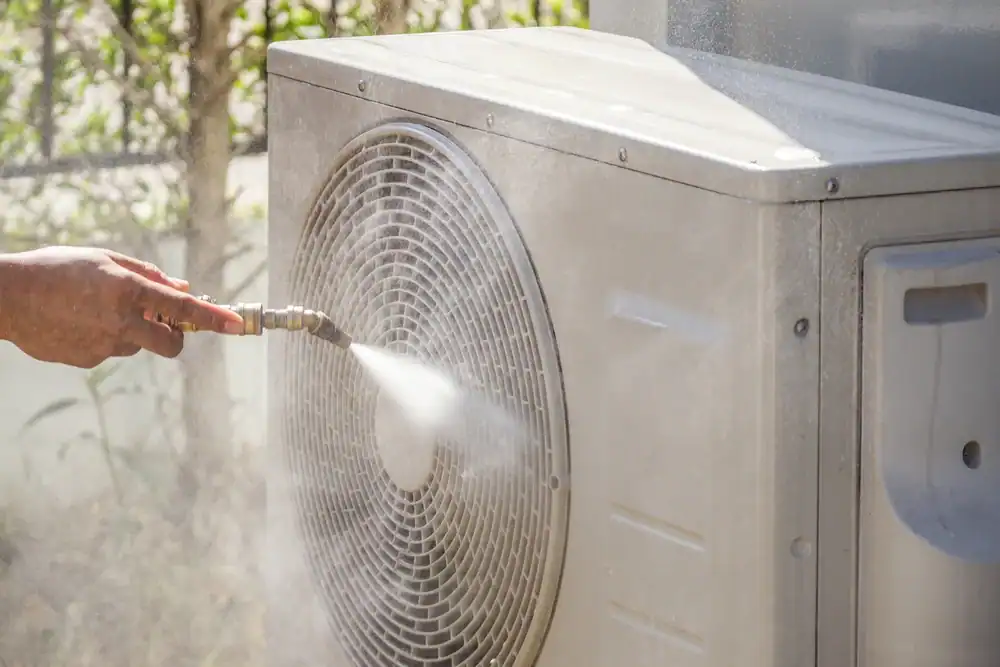
We clean your condenser coils, check refrigerant levels, test electrical connections, inspect your blower motor, and make sure your condensate drain isn’t clogged. These are the things that cause 90% of mid-summer breakdowns. A dirty coil makes your system work 20-30% harder. Low refrigerant means poor cooling and higher bills. A clogged drain can flood your basement or damage your air handler.
Regular maintenance also keeps your manufacturer’s warranty valid. Most warranties require proof of annual service. And if you’re planning to sell your home, having maintenance records shows buyers the system was cared for. That can be worth thousands in negotiating power.
If your system is under 10 years old and the repair costs less than $1,000, repair it. If it’s over 15 years old and needs a major repair—compressor, coil, or refrigerant leak—replacement usually makes more sense.
Here’s the math: older systems run at 8-10 SEER efficiency. New systems start at 14 SEER and go up to 20+. If you’re spending $200+ per month cooling your home in summer, a new high-efficiency system could cut that by $75-100 monthly. That’s $900-1,200 per year in savings.
Also consider the refrigerant issue. If your system uses R-410A and needs a refrigerant recharge, that repair is getting more expensive every month. R-410A production stopped in 2025, and prices are climbing. If you’re facing a $2,000 repair on a 12-year-old system, putting that money toward a new system with a 10-year warranty makes more financial sense.
Yes. We work with financing partners that offer flexible payment plans, including options with low monthly payments and deferred interest periods.
A new AC system is a significant investment, but it shouldn’t force you to drain your savings or put off other important expenses. Financing lets you get the comfort and efficiency you need now while spreading the cost over time.
We’ll walk you through the application process—it takes about 10 minutes and you’ll get an approval decision right away. There’s no pressure to use financing. Some customers prefer to pay outright, others want to preserve cash flow. We just want to make sure cost isn’t the only thing preventing you from being comfortable in your own home.
Central air uses ductwork to distribute cool air throughout your home from one indoor unit. Ductless mini-splits use individual air handlers in each room or zone, connected to an outdoor compressor by refrigerant lines.
If you already have ductwork in good condition, central air is usually the most cost-effective option. But many Union Beach homes either don’t have ducts or have ducts in poor shape—leaky, undersized, or poorly insulated. Adding or replacing ductwork can cost $5,000-10,000 on top of the AC system.
Ductless systems avoid that cost entirely. They’re also more efficient because you’re not losing 20-30% of your cooling to duct leaks. And you get zone control—you can keep bedrooms cooler at night without overcooling the rest of the house. Installation is less invasive too. We drill a small hole for the refrigerant lines, mount the indoor units, and you’re done. No tearing into ceilings or walls.