Wondering if that sewer line repair quote is fair? Learn how camera inspections, trenchless technology, and transparent pricing can save you thousands on your next sewer service.
Share:
Summary:
You’re standing in your basement watching water back up through the floor drain. Or maybe you’ve noticed that foul smell near your foundation that won’t go away. Either way, you know you need sewer line services—and you’re bracing for the bill.
Here’s what most Monmouth County homeowners don’t realize: the lowest quote isn’t always the best value, and the highest price doesn’t guarantee quality work. The difference between a smart investment and an expensive mistake often comes down to understanding what you’re actually paying for. This guide walks you through the cost factors that matter, the services that deliver real value, and how to make decisions that protect your home without emptying your savings.
When you call for sewer line services, you’re not just paying for pipe repair. You’re paying for diagnosis, labor, materials, equipment, permits, and often property restoration. The total can range from a few hundred dollars for a simple drain cleaning to $15,000 or more for full replacement with traditional excavation.
Most Monmouth County, NJ homeowners spend between $2,500 and $7,000 on sewer work. That wide range exists because no two situations are identical. A 10-foot section of damaged pipe under your lawn costs dramatically less than replacing 80 feet of line that runs under your driveway and garden beds.
The method you choose changes everything. Traditional dig-and-replace might quote at $50-$250 per linear foot for the plumbing work itself. But that number doesn’t include breaking up your concrete driveway, removing mature landscaping, or putting it all back together afterward. Those restoration costs can add $2,000 to $8,000 to your final bill—expenses that often don’t appear in the initial estimate.

Before anyone should quote you a repair price, they need to see what’s actually happening underground. That’s where camera inspection comes in. A sewer line camera inspection typically costs between $125 and $500 in Monmouth County, NJ, depending on the length of your line and how accessible it is.
This isn’t an optional step you should skip to save money. Without a camera inspection, your plumber is guessing. They might tell you the entire line needs replacement when only a 4-foot section has root damage. Or they might attempt a repair on a pipe that’s already collapsed and needs full replacement. Either scenario costs you thousands in wasted work.
The camera reveals exactly where the problem is, how severe it is, and what’s causing it. You get visual proof—actual footage of roots breaking through joints, cracks in the pipe, or buildup causing blockages. We credit the inspection fee toward your repair when you hire us for the work.
Think of it this way: spending $300 on a sewer camera inspection might save you $3,000 by avoiding unnecessary work. In Monmouth County’s older neighborhoods where tree roots commonly invade pre-1980s clay pipes, that camera often shows problems you didn’t even know existed. Finding them early, before they cause sewage backups or foundation damage, is worth every penny.
The inspection also gives you leverage. When you have video documentation of the actual problem, you can get multiple quotes based on the same information. You’re comparing apples to apples instead of trusting whoever sounds most convincing on the phone.
Several factors determine what you’ll actually pay for sewer line services, and understanding them helps you spot fair pricing versus inflated quotes.
Pipe length and depth matter significantly. A sewer line buried 2 feet down is easier and cheaper to access than one 6 feet underground. Longer runs require more materials and labor. Most residential sewer lines in Monmouth County, NJ run 40 to 100 feet from the house to the street connection.
The pipe material you’re working with also affects cost. Replacing old clay or cast iron with modern PVC is straightforward. But if you’re in an area that requires specific materials or you’re dealing with Orangeburg pipe (a compressed wood fiber product used in mid-century homes), the work gets more complex.
Access is huge. If your sewer line runs under an open lawn, great. If it’s under your newly paved driveway, mature oak tree, or custom patio, the cost jumps because of what needs to be removed and restored. Some companies lowball the plumbing quote but don’t mention you’ll need to hire a separate contractor to fix your landscaping afterward.
Labor rates in New Jersey reflect our cost of living and the skill required. Expect to pay $75-$200 per hour for licensed, insured professionals. That rate includes expertise, proper equipment, insurance coverage, and compliance with local codes. The guy offering to do it for $40 an hour probably isn’t licensed, insured, or pulling the required permits—which means you’re liable if something goes wrong.
Permits and inspections add to the cost but protect you legally. Monmouth County requires permits for most sewer line work. We handle this for you and build it into the quote. If someone suggests skipping permits to “save money,” walk away. Unpermitted work can haunt you when you sell your home or file an insurance claim.
The repair-versus-replacement question keeps homeowners up at night. Repair costs less upfront, but will you just be throwing money at a temporary fix? Replacement costs more now, but does it actually deliver better long-term value?
The honest answer depends on what the camera inspection reveals. A localized crack or small section of root intrusion? Repair makes perfect sense and typically runs $1,500 to $4,000. Multiple problems spread throughout the line, severe deterioration, or pipes at the end of their lifespan? Replacement is the smarter investment at $3,000 to $10,000.
Here’s what matters: a quality repair on a fundamentally sound pipe can last 10-20 years or more. But patching a pipe that’s failing in multiple spots just delays the inevitable replacement you’ll need in two or three years anyway. You end up paying for the repair and the replacement.

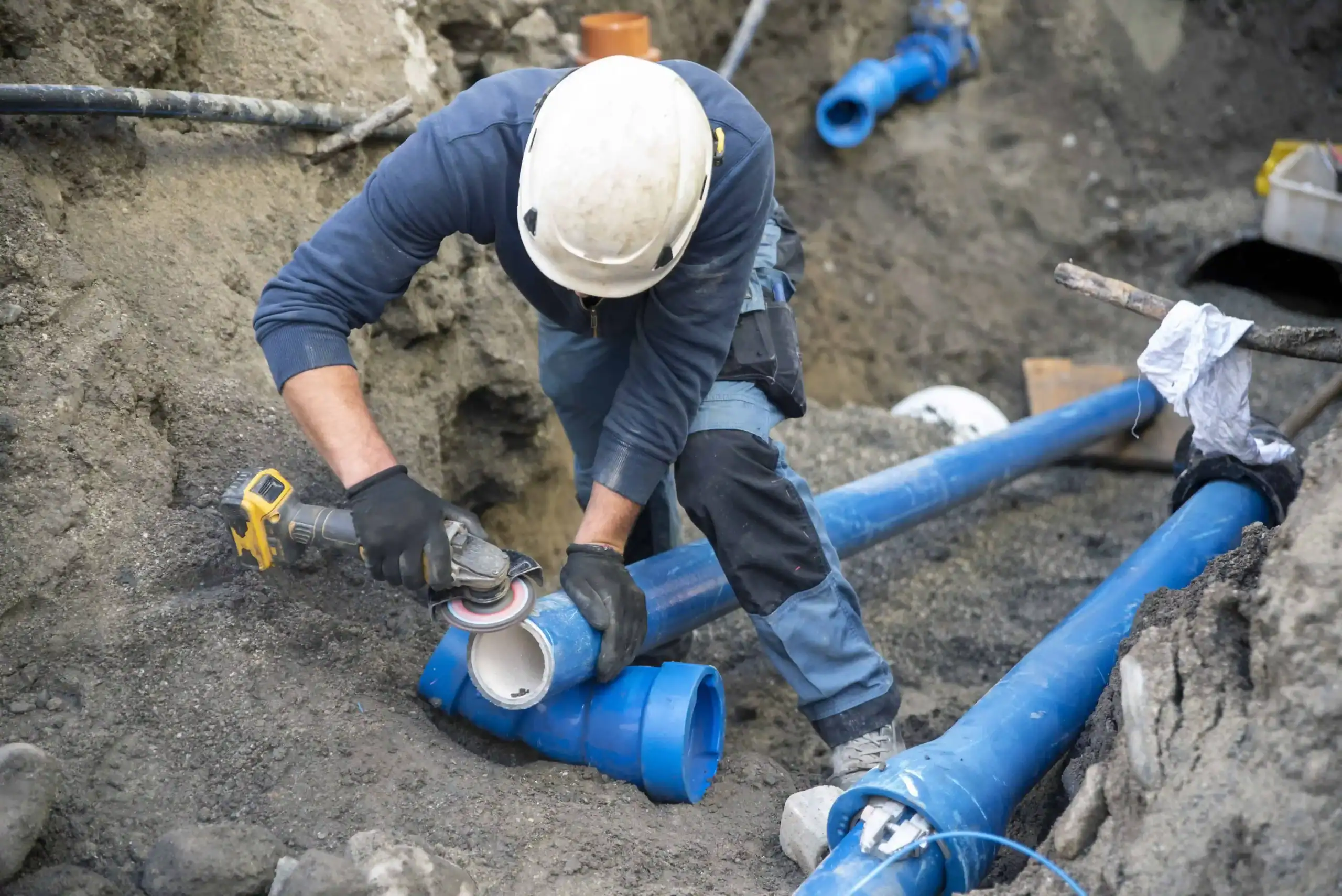
Trenchless technology changed the economics of sewer work completely. Instead of digging a trench across your entire property, trenchless methods access your sewer line through one or two small entry points.
Pipe lining (also called CIPP or cured-in-place pipe) costs $80-$250 per linear foot. A technician inserts a resin-coated liner into your existing pipe, inflates it, and cures it in place. You essentially get a brand new pipe inside the old one. The new liner is seamless, resistant to roots, and rated to last 50+ years. Total project cost typically runs $2,500 to $8,000 for most residential lines.
Pipe bursting runs $60-$200 per linear foot. This method pulls new pipe through the old one while simultaneously breaking apart the damaged pipe. You get a complete replacement along the same path without the massive excavation. Projects usually cost $3,000 to $10,000 depending on length.
Compare that to traditional excavation at $50-$250 per linear foot for the pipe work—which sounds cheaper until you add restoration. Digging up your driveway costs $8-$18 per square foot to replace. Mature trees run $500-$3,000 each. Landscaping restoration adds $2,000-$5,000 easily. Suddenly that “cheaper” traditional method costs $12,000-$25,000 total.
Trenchless methods complete in one to two days instead of a week. Your lawn stays intact. Your driveway doesn’t need repaving. Your landscaping survives. When you factor in total project cost including restoration, trenchless often saves 30-50% while delivering a longer-lasting result.
The catch? Trenchless doesn’t work for every situation. Severely collapsed pipes, extreme bellies in the line, or pipes with major offsets may require traditional excavation. That’s another reason the camera inspection matters—it tells you which methods are actually viable for your specific situation.
A sewer line camera inspection does more than just find problems. It prevents the single biggest mistake homeowners make: paying for work based on assumptions instead of facts.
The process is straightforward. We feed a specialized waterproof camera through your sewer line, usually accessing through a cleanout or by removing a toilet. The camera has lights and can navigate bends in the pipe. As it moves through, it records everything—cracks, root intrusion, buildup, bellies, offsets, or collapses.
You should see this footage yourself. We show you exactly what we’re seeing and explain it in plain language. You’re not taking anyone’s word for it. You’re looking at the actual condition of your pipes.
The camera also has a locator that pinpoints exactly where problems exist. Instead of guessing that roots are “somewhere near the oak tree,” we can mark the precise spot on your lawn. This accuracy matters enormously for repairs because you’re only digging or accessing the damaged section, not exploratory trenching to find it.
For Monmouth County, NJ homeowners, camera inspections often reveal issues common to our area. Tree root intrusion is the number one problem in neighborhoods with mature landscaping. Older clay tile pipes have multiple joints where roots easily penetrate. Cast iron pipes from pre-1970s homes corrode over time. Orangeburg pipe, used in some mid-century developments, compresses and collapses.
The inspection also catches problems before they become emergencies. Maybe you called because of slow drains, and the camera shows minor root intrusion that can be cleared with hydro jetting. But it also reveals a belly in the line 20 feet downstream that’s collecting debris and will cause a backup within the year. Now you can plan and budget instead of dealing with sewage in your basement at 2 AM.
Smart homeowners also use camera inspections proactively. If you’re buying a home built before 1980, a $300 sewer inspection can reveal a $10,000 problem before you close. If you’re selling, documentation of a clean sewer line adds value and prevents deals from falling apart during the buyer’s inspection period.
Sewer line services represent a significant investment, but the right approach turns a stressful situation into a manageable project with predictable costs and lasting results. Start with a camera inspection to know exactly what you’re dealing with. Compare the total project cost of different methods, not just the pipe work itself. And choose a company that offers upfront pricing, modern technology, and the financing options that make necessary work affordable.
In Monmouth County’s mix of older and newer homes, sewer line issues are common but completely manageable when you work with professionals who prioritize transparency and quality. Whether you’re facing an emergency backup or planning proactive maintenance, understanding the cost-versus-value equation helps you protect your property investment and your peace of mind.
At AME Plumbing Heating and Cooling, we serve Monmouth and Ocean County with camera inspections, trenchless repair options, and upfront pricing that eliminates surprises. Our team can walk you through your options and help you make the decision that’s right for your home and budget.
Article details:
Share:
Continue learning: